Water Salinity
 ADD TO E-PORTFOLIO
 SUGGEST AN EDIT
ADD TO E-PORTFOLIO
SUGGEST AN EDIT
SUGGEST AN EDIT
ADD TO E-PORTFOLIO
SUGGEST AN EDIT
EO Capability Benefits
EO-based monitoring enables the detection of salinity variations over large areas with consistent temporal coverage. It is especially valuable in regions where in situ monitoring is sparse or logistically challenging. When combined with other parameters such as sea surface temperature, turbidity, and chlorophyll-a concentration, salinity data enhances the understanding of oceanographic processes and supports integrated marine and coastal management. It contributes to early warning systems, water quality assessments, and the planning of climate adaptation and ecosystem protection strategies. Salinity information is particularly useful for modelling ocean dynamics, assessing freshwater-marine interactions, and supporting the sustainable management of aquatic environments.
EO Capability Description
Monitoring water salinity through Earth Observation (EO) technologies is essential for understanding the physical and chemical dynamics of coastal and marine environments. Salinity, along with temperature and pressure, determines seawater density, which influences ocean circulation, stratification, and mixing processes. These, in turn, affect nutrient distribution, biological productivity, and the overall health of marine ecosystems.
Changes in salinity can indicate freshwater inflows from rivers, rainfall, or melting ice, as well as evaporation and upwelling events. Abnormal salinity levels may disrupt the balance of marine habitats, influence the behaviour and distribution of aquatic species, and impact fisheries, aquaculture, and coastal livelihoods. Tracking salinity patterns also provides insights into estuarine dynamics, nutrient cycling, and the potential for harmful algal bloom development.
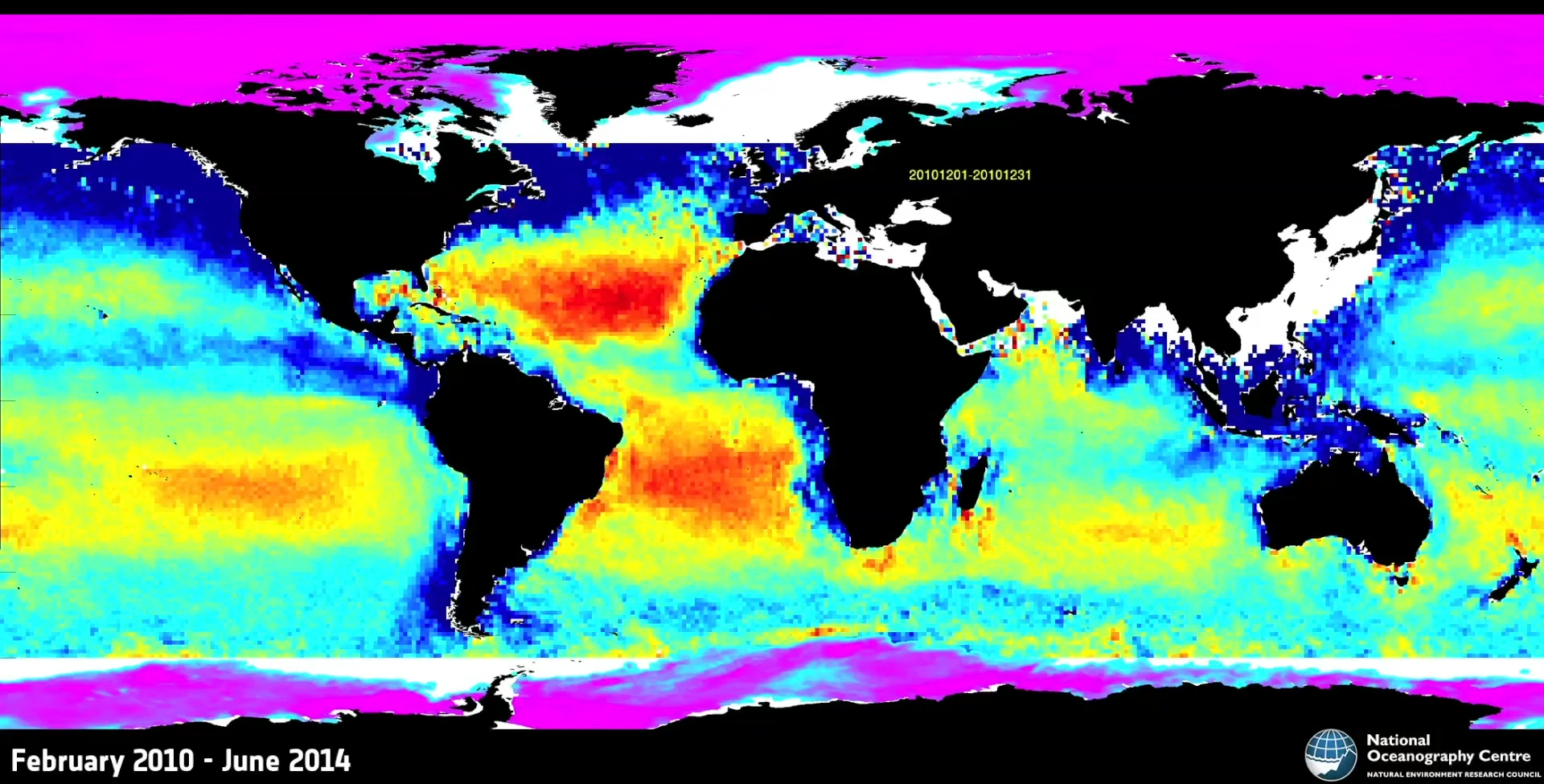
This capability relies on satellite-derived ocean data products generated through numerical models that assimilate both in situ observations and satellite measurements. The salinity data represents surface or near-surface seawater salinity, typically expressed in practical salinity units (PSU), and is available at regular spatial and temporal intervals. Satellite-based systems do not directly sense salinity; instead, it is estimated through model outputs that incorporate Earth Observation inputs such as sea surface temperature, sea level, wind, and ocean colour, along with physical oceanographic data. The data is processed to produce consistent, quality-controlled salinity fields over open and coastal waters.
For spatial analysis, salinity data is extracted over defined marine zones. These zones are delineated based on environmental features, proximity to freshwater inputs, or management boundaries. Within each zone, monthly averages are calculated from daily values, resulting in a time series that reflects the variability and trends in salinity. Outputs include georeferenced salinity maps and time-series graphs, which support long-term monitoring and anomaly detection. These datasets can be used independently or integrated into broader marine assessments and planning tools.