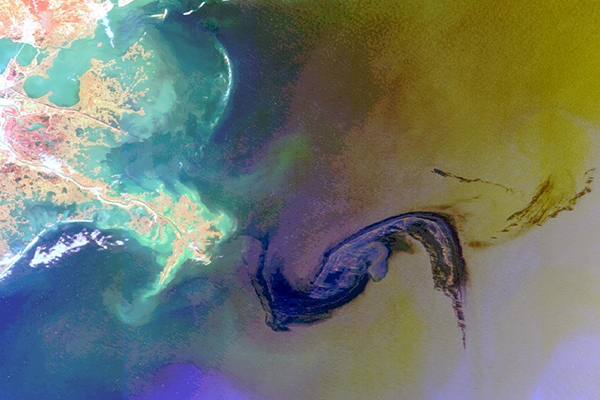
Oil Slicks
 ADD TO E-PORTFOLIO
 SUGGEST AN EDIT
ADD TO E-PORTFOLIO
SUGGEST AN EDIT
SUGGEST AN EDIT
ADD TO E-PORTFOLIO
SUGGEST AN EDIT
EO Capability Benefits
Satellite-based oil slick detection provides a wide-area, frequent, and relatively low-cost solution for monitoring marine oil pollution, and is now used operationally for both emergency response and routine surveillance against illegal discharges. These capabilities translate into real-world applications such as rapid mapping of major spills (e.g. the 2010 Deepwater Horizon oil spill), continuous monitoring along shipping lanes and offshore fields, and enforcement services like the EU’s CleanSeaNet supporting Europe’s coastal states. Advances in machine learning and ongoing foundational research are improving the thematic accuracy of mapped oil slick extents. Although false positives remain a challenge, these capabilities supports a more reliable distinction of oil types and relative estimates of oil concentration, volume and thickness under favourable observing conditions.
EO Capability Description
Synthetic Aperture Radar (SAR) is the primary technology for offshore oil slick detection because oil dampens short cavity‑capillary waves producing radar “dark spots”. A key challenge is distinguishing the morphology and texture of a suspected oil slick from other features that can also produce similar backscatter in SAR imagery. Examples include floating algae, phytoplankton aggregating at the sea surface, freshwater slicks, or zones where the surface currents changes over a short distance, known as “current shears”, which accumulate other floating materials.
Low-to-high resolution multispectral optical sensors for detection rely on how surface oil or oil-water mixtures alter the absorption and reflection of sunlight in the visible, near‑infrared (NIR) and shortwave infrared (SWIR) bands relative to nearby oil-free water. These methods are limited by the usual constraints of optical imagery (cloud cover, haze, daylight), as well as by water type and mixing, viewing geometry (sun-glint) and environmental factors such as phytoplankton, other suspended or floating materials and bottom reflectance. This can lead to different observing conditions and contexts reversing the relative reflectance of oil-containing pixels. In addition, as with other EO observations, each pixel averages out the spectral signatures of surface water patches with and without oil present leading to the mixed pixel effect.
Once oil‑containing pixels are delineated, and under suitable sun‑glint conditions, spectral signatures in the NIR–SWIR can be used to distinguish non‑emulsified oil from emulsions and to further separate oil‑in‑water from water‑in‑oil emulsions. For these classes, laboratory‑derived relationships between reflectance and oil properties allow relative estimates of concentration and, in specific cases (especially for water‑in‑oil emulsions and when hyperspectral SWIR data are available and calibrated), relative or sometimes absolute oil volume or thickness per pixel.